
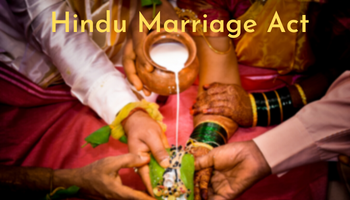
The Hindu Marriage Act 1955 is the main law that governs Hindu marriages in India. If you’re searching for the bare act of Hindu Marriage Act or want to understand the Hindu Marriage bare act in simple words, this blog is for you. It explains who the Hindu Marriage Act 1955 applies to, the eligibility to marry, key features of the Act, how to register a Hindu marriage in India.
What is the Hindu Marriage Act
he Hindu Marriage Act, 1955 is a personal law enacted by the Parliament of India to regulate Hindu marriages and related matters. It applies to Hindus, Buddhists, Jains, and Sikhs. Following are the legal guidelines of Hindu marriage act:
- A valid Hindu marriage
- Rights and duties of husband and wife
- Divorce (mutual or contested)
- Judicial separation
- Maintenance and alimony
- Annulment of marriage
- Marriage registration
The Act ensures Hindu marriages follow a legal framework, offering protection to both spouses in case of disputes.
Purpose of the Hindu Marriage Act 1955
he Hindu Marriage Act, 1955 is a personal law enacted by the Parliament of India to regulate Hindu marriages and related matters. It applies to Hindus, Buddhists, Jains, and Sikhs. Following are the legal guidelines of Hindu marriage act:
- A valid Hindu marriage
- Rights and duties of husband and wife
- Divorce (mutual or contested)
- Judicial separation
- Maintenance and alimony
- Annulment of marriage
- Marriage registration
The Act ensures Hindu marriages follow a legal framework, offering protection to both spouses in case of disputes.
Salient Features of the Act
- Forbids bigamy: Section 5 of the Act makes it illegal for a Hindu to have more than one living spouse at a time (bigamy)
- Marriageable age prescribed: As per Section 5 (iii) of the Act, the groom must be at least 21 years old and the bride must be at least 18 years old during the time of marriage
- Restitution of conjugal rights: The restitution of conjugal rights is stated in Section 9 of the 1955 Act. Restitution of conjugal rights refers to the right of a couple to cohabitate. The main motive behind Section 9 is that a spouse has the right to live together in order to safeguard their union and preserve its sanctity
- Focus on the mental stability of the parties: A person’s marriage will be null and void if they were mentally unfit when they were married
- Providing significance to ceremonies involved in marriage: The Hindu Marriage Act dictates that if two Hindu people get married using the conventional rituals and rights, their marriage is lawful
Applicability of the Hindu Marriage Act 1955
The Hindu Marriage Act, 1955 applies to any person who:
- Is Hindu by religion in any of its forms, including Virashaiva and Lingayat
- Follows Brahmo, Prarthana, or Arya Samaj
- Is a Sikh, Buddhist, or Jain
The Act applies to people who live in the states where it is in effect, who are not Muslim, Christian, Parsi, or Jewish, unless it can be shown that they would not have been governed by Hindu law, tradition, or custom.
Eligibility Criteria to Marry Under the Hindu Marriage Act, 1955
Under the Hindu Marriage Act, 1955, two Hindus can marry if the following criteria are met:
- No existing spouse: Neither the bride nor the groom can have living spouse at the time of the marriage.
- Mental fitness: At the time of the marriage, neither the bride nor the groom:
- Is incapable of giving valid consent due to unsound mind.
- Has a mental illness that makes them unfit for marriage and having children, even if they can give consent.
- Has been subject to repeated attacks of insanity.
- Minimum age:
- The groom must be at least 21 years old.
- The bride must be at least 18 years old at the time of the marriage.
- Prohibited relationships:
- The bride and groom must not be within the degrees of prohibited relationship, unless a custom of their community allows such a marriage.
- Sapindas:
- The bride and groom must not be sapindas (blood relatives within a certain degree) of each other unless a custom of their community permits such a marriage.
Marriage Registration under the Hindu Marriage Act 1955
You can register your marriage at the Sub-registrar office in your area. You can apply for marriage online on your state’s portal and choose a day to register your marriage at the registry office. Just needs to carry your documents, wedding card, and 3 other witnesses to complete the registration procedure.
Section 8 of the Hindu Marriage Act 1955 lays down that the marriage be instantly recorded by the Registrar of Marriage on the same working day in the Hindu Marriage Register. On the day of your appointment, the registrar will verify all documents and register your marriage. The next working day, you will receive a marriage certificate.
Divorce under the Hindu Marriage Act 1955
The Hindu Marriage Act 1955 was the first Hindu personal law to legally allow divorce. Before this, Hindu marriage was considered a permanent and sacred bond with no legal provision for ending it. The Act introduced clear legal grounds and processes for divorce.
Nullity and Voidable Marriages
Sections 11 and 12 of the Hindu Marriage Act cover marriages that can be declared null and void:
- A marriage is void if it violates the core conditions for a valid Hindu marriage (such as bigamy or being within a prohibited relationship).
- A marriage is voidable under Section 12 if there are specific flaws—such as the marriage happening under force or fraud, or one party being impotent.
Judicial Separation
Judicial Separation is the pre-divorce phase and the law states that any one of the parties may petition for judicial separation on valid grounds or reasons detrimental for a divorce. If the court approves the judicial separation, the parties will no longer have to live together.
Divorce
Grounds for Divorce – Section 13
Section 13 of the Hindu Marriage Act 1955 provides nine specific fault-based grounds for divorce, such as:
- Adultery
- Cruelty
- Desertion for at least 2 years
- Mental disorder or insanity
- Conversion to another religion
- Leprosy or venereal disease
- Renunciation of the world
- Presumed death (missing for 7 years)
Either the husband or wife must prove at least one valid ground to get a divorce.
Divorce by Mutual Consent – Section 13B
Section 13(B) of the Marriage Laws (Amendment) Act of 1976 allows divorce by mutual consent. The couple can jointly file for divorce if:
- They have been living separately for at least one year.
- They are unable to live together.
- They mutually agree to end the marriage.
This petition must be filed in a District Court, and no blame is needed on either side.
FAQs
What is the Hindu Marriage Act 1955?
The Hindu Marriage Act 1955 is a personal law enacted by the Indian Parliament to regulate marriage, divorce, and related matters among Hindus.
Can I remarry under the Hindu Marriage Act?
Yes, under the Hindu Marriage Act 1955, you can remarry if:
- Your previous marriage has been legally dissolved through divorce or annulment
- Your spouse has passed away
Remarrying without legal separation may be considered bigamy, which is punishable under the bare act of Hindu Marriage Act.
What happens if marriage isn't registered?
If a Hindu marriage isn’t registered, it is still valid under the Hindu Marriage Act 1955 if all the essential rituals were performed. But, not registering can create problems when applying for legal documents, visa, or during disputes. Registration provides legal proof of marriage.

Leave a Reply