
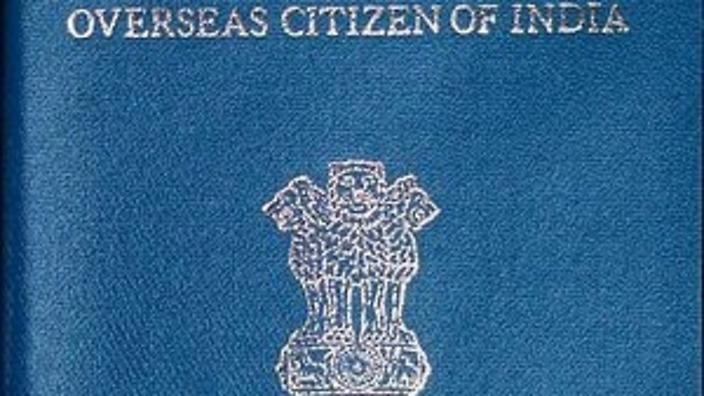


OCI is an immigration status that is granted to foreign nationals of Indian origin. OCI, or Overseas Citizenship of India status, was introduced by the Citizenship (Amendment) Act, 2005. It enables the eligible citizen to live and work in the Republic of India as long as they want. It was introduced in response to the demand for dual citizenship for those who have roots in India but hold passports of countries other than India. This blog explains all about the OCI card in detail.
OCI card
OCI card is issued to Indian origin foreign nationals. This special status of overseas citizen of India card makes it easier for them to start their own business or find employment in India.
Earlier, a lifelong “U” visa sticker was pasted in the passport for OCI card holders. This visa sticker has now been discontinued. Instead, the OCI card itself serves as proof of lifelong visa.
While travelling to and from India, an OCI cardholder must carry both the OCI card and a valid passport. You need to show both documents to immigration officers and airport authorities.
An OCI card is also issued to people who have settled in other countries or whose parents or grandparents were originally from India.
Is a person with OCI status a citizen of India
No, OCI card holders are not the citizens of India. OCI allows visa free travel to India. They can inherit property in India from their parents or ancestors. They can also study or take educational courses in India.
Following are the things that are not allowed for OCI card holders:
- OCI card holders do not have the right to vote in India
- They cannot contest local, state, or national elections
- They are not allowed to hold constitutional offices in India
- They cannot purchase agricultural land, plantation land, or farmhouses
Although the Indian Government doesn’t grant dual citizenship, OCI cardholders can apply for a grant of Indian citizenship if they fulfil the following criteria:
- The person should have taken up residence in India for at least twelve months before making an application for registration
- They can apply for Indian citizenship after five years of issuance of the OCI status
Benefits of OCI card
Following are the benefits of OCI card:
- OCI status allows multiple entries with a multipurpose lifelong visa to visit India
- OCI cardholders are exempt from registering with FRRO (Foreigners Regional Registration Officer), which is otherwise mandatory for foreign nationals who visit India on a long-term visa
- They are also permitted to undertake educational, financial and economic activiteis in India
- They are given equal rights as Indian citizens abroad in matters of entry into national parks and wildlife sanctuaries, domestic airfares, and intercountry adoption of Indian children
- OCI card facilitates the transaction process and reduces the expected risks connected with business or education activities by virtue of being excused from registrations and related formalities
- OCI cardholders can travel at very short notice
Limitations associated with OCI card
Following are the limitations of OCI card:
- OCI status is not allowed for contesting elections to hold the offices of President of India, Vice-President of India, Member of Lok Sabha, Member of Rajya Sabha, Member of Legislative Assembly, Member of Legislative Council, Chief Justice of India, Supreme Court Judge, or High Court Judge.
- They are required to apply for an ILP (Inner Line Permit) and/or PAP (Protected Area Permit) to travel certain areas in India like Nagaland, Mizoram and Arunachal Pradesh.
- For research, they need to apply at the Indian Diplomatic Mission nearest to them to get No Objection Certificate or a Research Project Clearance Certificate from the Ministry of Home Affairs
- Aadhar cards can’t be issued to Overseas Citizens of India, making it difficult to get your hands on SIM cards for mobile phones, buying insurance policies, etc
OCI card requirements
Following are the requirements to register as an Overseas Citizen of India:
- The person should have been a citizen of India on 26 January 1950 or at any time thereafter or was eligible to become a citizen of India on 26 January 1950
- They should have belonged to territory that became part of India after 15 August 1947
- A child, grandchild, or great-grandchild of such a citizen
- He or she is a minor child and both the parents are citizens of India or one of the parents is a citizen of India
- They could be a spouse of foreign origin of citizen of India or spouse of foreign origin of an Overseas Citizen of India cardholder, registered under section 7A of the Citizenship Act, 1955. The marriage should have been registered and subsisted for a continuous period of at least 2 years before the registration of the OCI application.
Documents required to apply for OCI status
Following are the documents required for the registration for the Overseas Citizen of India card:
- Proof of Indian citizenship
- Birth certificate, if you were born in India on or after 26th January 1950, but before 1st July 1987
- Your birth certificate along with one of your parent’s birth certificate may suffice as Indian Citizenship proof, if you were born after 1st July 1987
- Citizenship proofs as well as your birth certificate for both parents, if you were born in India on or after 3rd December 2004, and only if both parents are Indians, or if at least one of the parents is a citizen of India and the other one is not an illegal immigrant at the time of birth in India
- A passport (with a validity of at least 6 months) or voter ID card may be considered citizenship proof in conjunction with the birth certificate
- Evidence of self or parents or grandparents or great-grandparents holding Indian citizenship
- Proof of relationship as a parent, grandparent or great grandparent, if their Indian origin is claimed as basis for registration as OCI cardholder
- Proof as the spouse of foreign origin of citizen of India or spouse of foreign origin of an OCI cardholder
- Marriage certificate issued by a competent authority (if applicable)
- In case the parents are divorced, a court order of dissolution of marriage must be submitted, which categorically states that the legal custody of the child is with the parent
- Applicant’s image of dimensions 51 mm X 51 mm, with a plain light coloured background, in jpg or jpeg format and a maximum size of 200kb
- Applicant’s signature image with an aspect ratio of 1:3, in jpg or jpeg format and maximum size of 200kb
How to apply for OCI card in India
Following are the steps to apply for OCI card in India :
- Visit the official OCI application portal
- Register and login with user id
- Select “OCI application”
- Fill out Parts 1 and 2 of the application form
- Upload photograph and signature
- Complete Part-B of the registration process
- Upload supporting documents in PDF format at the end of Part-B
- Verify and submit the application form online
- Generate application form
- Note down the Application Reference Number for tracking
- Pay the OCI application fee online
- Visit FRRO/FRO office for document verification
- Processing at office
- Receive the OCI card after approval by post or collect
NOTE: Foreign nationals can travel with a valid passport and PIO card, if the date of their journey commenced on or before 30th September 2018.
Fees for OCI registration
Fees for OCI registration varies on the basis of where you apply:
- If applications submitted in India- Rs 15,000
- If applicationssubmitted from outside India-USD 275
NOTE: The fee for renewal or re-issuance of OCI documents is USD 25 abroad and INR 1,400 in India.
Where should I apply for OCI applications
You can submit OCI application form along with the fee challan at Foreigners Regional Registration Offices or at Indian Missions abroad.
Following are the locations of FRRO offices in India:
- The FRRO (Foreigner’s Regional Registration Officer) in Goa, Hyderabad, Mumbai, Delhi, Lucknow, Kolkata, Bangalore, and Amritsar
- The OCI Cell in Foreigners Division of Ministry of Home Affairs at the following address-
Under Secretary (Foreigners Division)
Ministry of Home Affairs,
Jaisalmer House.
26 Man Singh Road,
New Delhi – 110 011
OCI card application status
Following are the steps to check OCI card application status:
- Visit the official OCI website
- Click on Track My Application
- Enter application id and passport number
- Submit and view the status
Renewal of OCI card
Renewal of OCI is compulsory under the following circumstances only:
- OCI documents have to be reissued and the stipulated fee has to be paid every time
- Once an OCI holder reaches 50 years of age, they are required to get their OCI registration certificate and visa reissued. However, if you got your first OCI card when you were already 50 years of age or older, then re-issuance of an OCI card is not mandatory

How to apply for Passport online in India
US Visa Application from India
UK Visitor Visa fees from India
FAQs
Who is authorized to issue OCI status?
OCI status is granted by the Bureau of Immigration, which comes under the ambit of Union Home Ministry of the Government of India.
What is the full form of OCI?
Full form of OCI is Overseas Citizenship of India
How long does the OCI application processing take?
It takes 6-8 weeks to get OCI card from the Bureau of Immigration.
Will I receive SMS or email updates for OCI status?
Yes. you can receive email or SMS alerts at important stages of OCI card processing.

Riddhi
For NRIs applying through the Online OCI Card Application process, document consistency plays a crucial role. Even small mismatches in names or passport details can cause delays. Carefully checking photo specifications and document clarity before submission can make the process much smoother.